A breakthrough in
physical motion
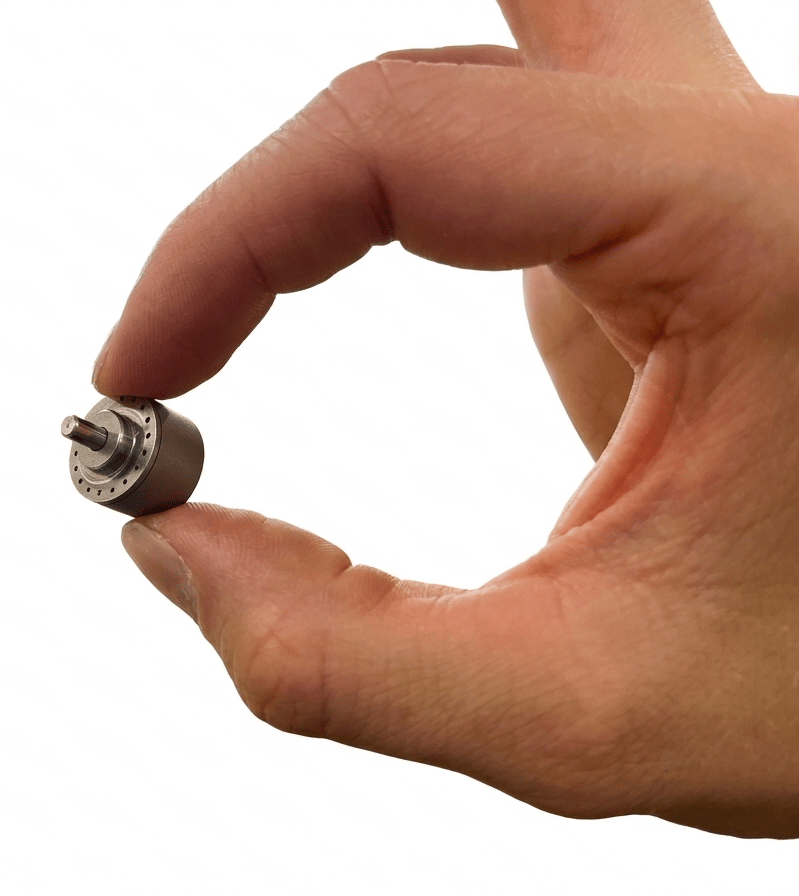
Sangtera's microhydraulic motors replace rare-earth magnets and copper coils with precision polymer thin-films, delivering a hundred times more torque for the same mass, with zero-power hold.
Polymer-based
Our motors user polymer thin-film technology, eliminating the dependence on supply chains for rare-earth magnets or copper coils.
100x stronger
Each motor consists of tens of layers, each with over 300 droplets. The force from all of these droplets is combined to produce 100x the torque-density of conventional electromagnetic motors.
Zero-power hold
Since our technology is based on electrostatics, it offers something no electromagnetic motor can—the ability to hold position without using power.
Electrostatics, reimagined
The journey of actuation started with electrostatic motors in the 18th century. Even so, they were rapid overtaken by electromagnetic motors, which used much lower operating voltages, provided greater energy density at large sizes, and were less susceptible to ambient dust and humidity.
Sangtera's technology has reimagined what is possible with electrostatics. By harnessing the power of suface tension at microscopic scale, we have developed an electrostatic motor that operates at 48–60 V, with 60-85% efficiency, and delivers 100x the torque density of best-in-class electromagnetic motors. And it offers a unique advantage of electrostatics—the ability to hold position without power consumption.
We call this technology, microhydraulic actuation.
Dexterous robots face major limitations
Dexterous robots can be equated with dexterous hands. But both geared micromotors and tendon-driven system face serious limitations in enabling human-like dexterity.
Geared micromotors
The first attempt at building dexterous hands, or end effectors, was by making electromagnetic motors smaller — a natural choice. But halving an EM motor’s dimensions makes its torque drop to one-eighth. To compensate, gears have to be added.
But, the higher the gear ratio, the stiffer the motor. This makes micromotors prone to breakage, and the loss in torque transparency prevents force feedback. Also, micromotors are inefficient — a lot of energy is lost as heat. And they are heavy.
Tendon-driven hands
In response to the limitations faced by geared micromotors, tendon-driven hands were developed. By pulling back motors to the elbow joint, larger motors with smaller gears could be used.
This, however, introduced new challenges. Tendons stretch and elongate, which makes them hard to simulate while training AI models. And they fray and break.
Heating and power cosumption
In both cases, electromagnetic motors burn energy just to maintain force. Heating and short battery life are seen as inevitable shortcomings.
Sangtera's microhydraulic motors
Invented at the MIT Lincoln Laboratory, Sangtera’s microhydraulic actuators harness the power of electrowetting to address all the constraints faced by conventional electromagnetic systems.
100x torque density
Microhydraulic actuation generates hundreds of times the specific torque of induction motors. This makes motors very responsive, accelerating to full power and speed in <125 µs.
Inherently backdrivable
With high torque density, high gear ratio are eliminated. Sangtera's motors are inherently backdrivable, with built-in position and force sensing.
Zero-power hold
Since our technology is based on electrostatics, energy is only used to move from one position to another. Staying still is not longer a battery drain.
Fine-grained control
The smallest step size is a droplet pitch, with an angular displacement of ~1°. Combined with its low inertia, this enables fine-grained control.
No rare-earth magnets
The droplet is the transmission and the lubricant. The solid-on-solid wear of a micromotor gearbox is designed out.
Scalable manufacturing process
Lorem ipsum dolor sit amet, consectetur adipiscing elit, sed do eiusmod tempor incididunt ut labore et dolore magna aliqua.
Investors








Awards & recognition
NEMC HUB announces $1.43M to 19 semiconductor companies
Apr 23, 2025
Sangtera chosen to be among 19 startups awarded by the Northeast Microelectronics Coalition (NEMC) Hub through its Powering Regional Opportunities for Prototyping Microelectronics (PROPEL) Operations Program.
Sangtera awarded $1.18M as Part of NSF STTR Phase II
Apr 1, 2025
The Small Business Technology Transfer (STTR) Phase II awarded $1.18 million to Sangtera for a project focused on designing, fabricating, and characterizing a small form-factor precision stage prototype to support high accuracy and high throughput chiplet-to-wafer hybrid bonding.
Sangtera funded by UK's robot dexterity program
Feb 10, 2025
Backed by £57m, ARIA's Robot Dexterity Program aims to transform robotic capabilities and unlock a step change in human productivity. Sangtera was awarded funding for technologies aimed at releasing the bottlenecks in robotic dexterity and creating vastly more capable and useful machines.
NEMC awards over $1M to advance microelectronic innovation
October 8, 2024
Feb 10, 2025
Sangtera was among 13 companies selected to be a part of a first-of-its-kind program that funds startups and small businesses developing next-generation microelectronics technologies.
Sangtera awarded $275,000 by the National Science Foundation
January 15, 2024
Sangtera awarded $275,000 by National Science Foundation as part of the Small Business Technology Transfer (STTR) Phase I project, to develop microhydraulic actuators for high-accurarcy, high-speed, position stages.