Thermal management and zero-power hold
Packing over a dozen active degrees of freedom into a palm and fingers the size of a human hand creates a thermal management challenge. Every joint requires an actuator, but inside a compact finger or wrist, there is virtually no room for cooling fans, liquid cooling loops, or heat sinks.
Energy is lost during motion, when the actuator moves. And it is lost when the robot is stationary, because of static holding power consumed when maintaining a posture.
Energy use in motion
EM motors operate on the Lorentz force, where an electric current I flowing through a conductor of length L within a magnetic flux density B generates a mechanical force:
EM motors operate on the Lorentz force, where an electric current I flowing through a conductor of length L within a magnetic flux density B generates a mechanical force:
$$\vec{F} = I (\vec{L} \times \vec{B})$$
On macroscopic scales, electric motors are remarkably efficient—often exceeding 90% conversion efficiency. However, when motor dimensions shrink down to the millimeter scale, scaling laws become brutally unfavorable.
As the size of an inductive coil shrinks, the volume available for copper wire decreases rapidly, requiring much thinner wire gauges to maintain the required turn count. The electrical resistance R of these miniature coils scales inversely with wire cross-sectional area. Resistive losses dominate at sub-gram mass scales.
Energy use in motion
On macroscopic scales, electric motors are remarkably efficient—often exceeding 90% conversion efficiency. However, when motor dimensions shrink down to the millimeter scale, scaling laws become brutally unfavorable.
As the size of an inductive coil shrinks, the volume available for copper wire decreases rapidly, requiring much thinner wire gauges to maintain the required turn count. The electrical resistance R of these miniature coils scales inversely with wire cross-sectional area. Resistive losses dominate at sub-gram mass scales.
Dimension
Tendon-driven hands
Micromotor-driven
Payload
By moving the motor away from the hand onto the elbow, larger motors can be utilized. This makes hands strong enough to perform tasks like lifting up a bottle of water.
Micromotors’ torque is limited by their size — which, in turn, is constrained by the space available inside the robotic hand’s finger joints. To get sufficient range of motion, high gear ratios are used. This further limits the torque.
Heating
The position of the motor allows for easier heat dissipation.
Small size limits heat dissipation. Failure due to overheating is likely.
Sim-to-real gap
Tendons interact in a complex manner. Many tendons can affect a single joint, and many joints can be affected by a single tendon. Also, they stretch with use. This makes their behavior hard to model.
Micromotors have high inertia and high friction. Both of these properties are difficult to model, and cause a sim-to-real gap. Origami Robotics has an excellent blog post on this subject.
Degrees of freedom
Multiple tendons can affect a single joint, and vice versa. The more DoF we add, the more complex and failure-prone the system becomes.
Direct placement of the micromotor on the joint makes it easier to create hands with more DoF. Proponents of this approach claim that more DoF translates to greater capabilities.
Speed of movement
Lower inertia and friction enables higher speed.
To overcome inertia and friction safely, speed has to be limited.
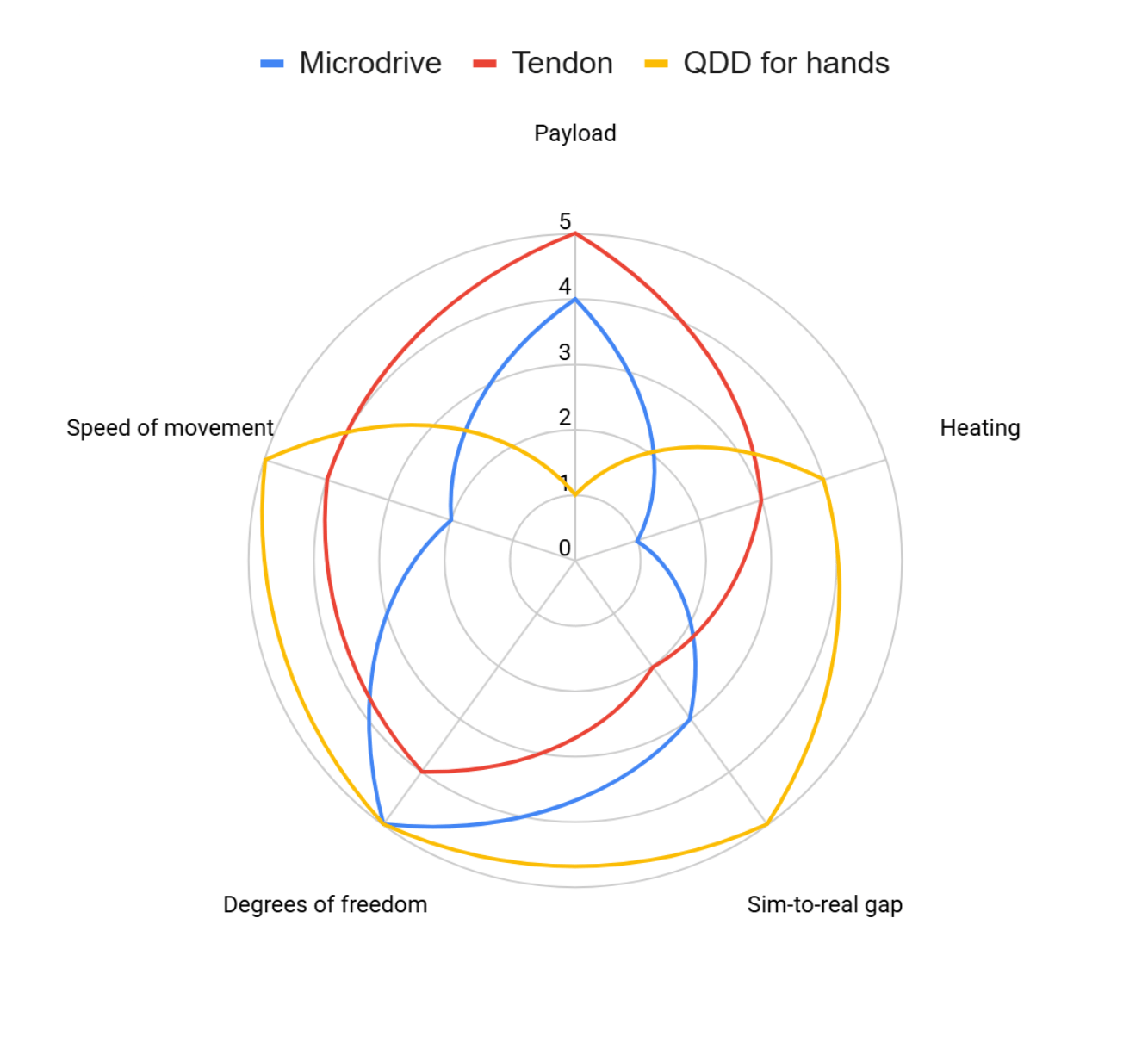
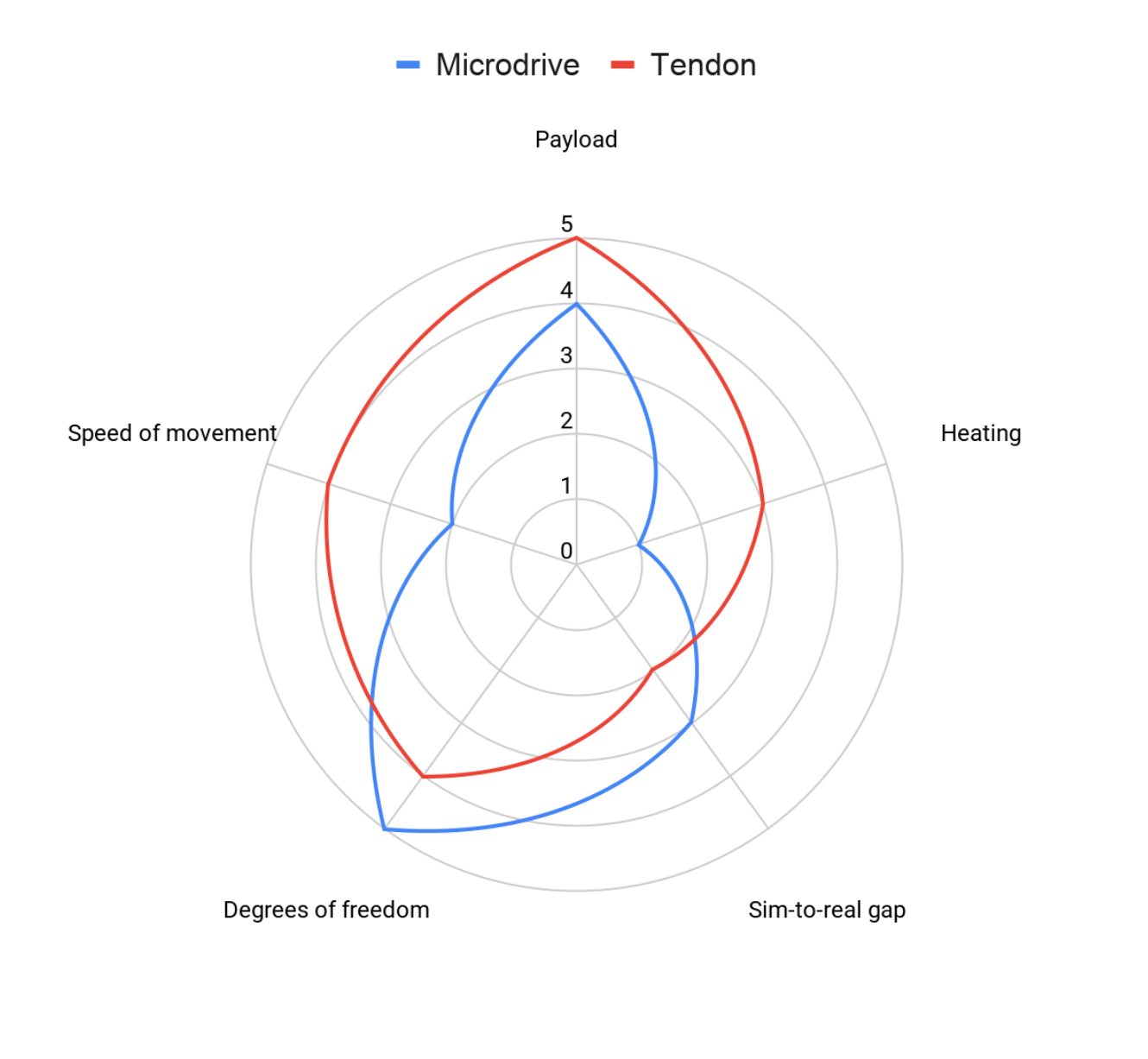
We have represented this table as a radial chart. The numbers are our interpretation.
A third approach has also been deployed recently. That of using low gear ratios with micromotors—quasi-direct drives (QDD) for hands. QDD has already established itself in legged locomotion, but capping the gear ratio dramatically decreases payload. The benefits—more speed, responsiveness, and lower sim-to-real gap.